
How Do You Make Your Metabolism Work for You?
Understanding what metabolism actually is, and the specific habits that support it, so you stop fighting your own body
Most people talk about metabolism as if it were a switch. Fast metabolism, slow metabolism, broken metabolism. Clients believe their bodies have been working against them for years, and no amount of effort will change that.
Here is the direct answer. Your metabolism is not a switch. It is the sum of everything your body does to convert food into energy, and while genetics set a baseline, the habits you build each week (how you eat, how you move, how you sleep, and how much muscle you carry) genuinely change how that energy gets used. You cannot rewrite your biology. You can absolutely work with it instead of against it.
That distinction matters more than any product or plan. This article walks through what the research actually shows, where the common advice goes wrong, and what to do about it starting this week.
Key Takeaways
- Metabolism is not fixed by age alone. Research shows it holds steady from your twenties through your fifties and only begins a true decline around age 60.
- Muscle tissue burns more energy at rest than fat tissue, which is why strength training has a lasting effect that cardio alone does not.
- Crash dieting can suppress your metabolic rate for years, not weeks, which is why slow and steady outperforms extreme restriction almost every time.
- The calories you burn outside of formal exercise, through walking, standing, and daily movement, often add up to more than your workout does.
- Protein takes more energy to digest than carbohydrates or fat, giving your food choices a small but real effect on your daily calorie burn.
Why Does Metabolism Feel Like Such a Mystery?
I have coached people in their twenties who were convinced their metabolism had already slowed down, and people in their fifties who assumed weight loss was no longer possible for their age group. Both were working from the same flawed idea: that metabolism declines steadily every year after your teens.
The frustration is real, even if the belief behind it is not accurate. Someone eats less, moves more, and still does not see the scale move the way they expect. When that happens for long enough, it is natural to look for something to blame, and metabolism becomes the easy answer. Clients quietly give up on strength goals because they assume their body has already decided the outcome.
The truth is more useful than the myth, but it takes some untangling.
Your metabolism is shaped by muscle mass, activity outside the gym, sleep, stress, and the composition of your diet, not just your birth certificate. Once you understand which of those factors you can influence, the whole conversation changes from “my metabolism is broken” to “here is what I can actually do.”
What Does the Research Say About Metabolism?
A large 2021 study published in the journal Science tracked more than 6,400 people between the ages of eight days and 95 years, across 29 countries, using a method called doubly labeled water to measure real-world energy expenditure. The researchers found that metabolism does not begin its true decline until after age 60, and even then the drop is gradual, at roughly 0.7 percent a year. Between your twenties and your fifties, metabolic rate stays remarkably stable. The steep decline people expect in their thirties and forties simply is not supported by this data.
Muscle mass tells a different, more actionable story. A review of strength training research found that ten weeks of resistance training can raise resting metabolic rate by around 7 percent, add roughly a pound and a half of lean muscle, and reduce fat mass at the same time.
The same research notes that inactive adults lose three to eight percent of their muscle mass every decade, and that loss brings resting metabolic rate down with it. This is the clearest, most repeatable lever available to anyone who wants to influence their metabolism directly.
Then there is the part of your day you are not tracking at all. Researchers at the Mayo Clinic, led by Dr. James Levine, coined the term non-exercise activity thermogenesis, or NEAT, to describe the energy you burn simply living: standing, fidgeting, taking the stairs, walking to your car. Levine’s research found that NEAT can vary by up to 2,000 calories a day between two people of similar size, depending almost entirely on how much they move outside of formal exercise. For most people, this single factor has a bigger effect on daily calorie burn than the workout itself.
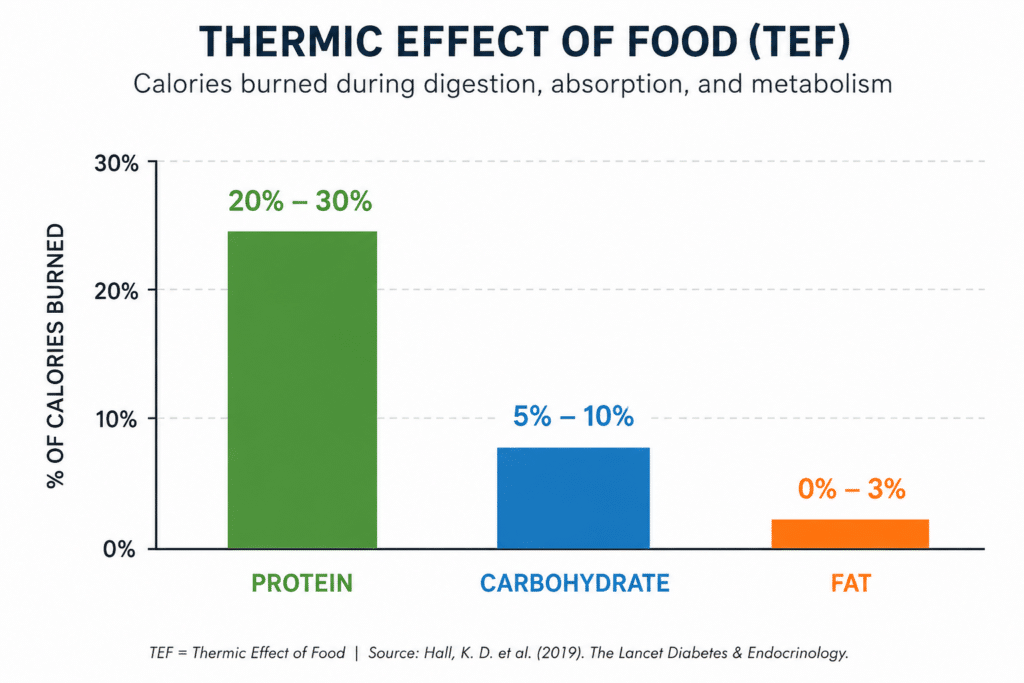
Diet composition plays a smaller, but still measurable, role. Digesting protein costs the body 20 to 30 percent of its calories, while carbohydrate costs 5 to 10 percent and fat costs almost nothing, between 0 and 3 percent. That is not a loophole for eating without limits, but it does mean that a higher protein diet burns slightly more energy just to be processed, on top of helping preserve the muscle mass that keeps resting metabolism higher.
Finally, the research on extreme dieting is a warning worth taking seriously. A well known study followed contestants from a televised weight loss competition after they lost enormous amounts of weight in a short window. Six years later, their bodies were burning roughly 500 fewer calories a day than would be predicted for their size, a suppression that had not resolved with time. Moderate, sustainable calorie restriction produces a far smaller and more temporary effect. The lesson is not that dieting is dangerous. It is that speed and severity carry a real metabolic cost.
The Reframe: Stop Chasing a Metabolism Boost. Build a Metabolism Baseline.
Most of what you see online treats metabolism as something to spike, through a supplement, a detox tea, or a workout promising to torch calories for the rest of the day. None of that reflects how metabolism actually works.
Muscle is baseline. Daily movement is baseline. Consistent, adequate eating is baseline. Sleep is baseline. Every one of those factors works slowly, in the background, whether you are paying attention to it or not. There is no single session or single meal that changes your metabolic rate in a lasting way. What changes it is what you repeat, week after week, for months. This is the single biggest mindset shift that gets people out of the all-or-nothing cycle.
This reframe also explains why so many diets fail long term. They chase a short-term spike instead of protecting the baseline. Extreme restriction lowers your baseline. Skipping strength training lets your baseline erode with age. Building the baseline, on the other hand, compounds in your favor for years.
How Do You Actually Build That Baseline?
This is where the work happens, and it looks less dramatic than most marketing promises, which is exactly why it works.
Strength training comes first, not cardio. When I put a new client on a structured strength program, most people expect the scale to be the first thing to change. What usually changes first is how their clothes fit and how much energy they have during the day, both signs that muscle is doing its job. Two to three full body strength sessions a week is enough to start building the muscle that raises your resting metabolic rate.
Daily movement matters as much as your workout. Given how much NEAT contributes to daily calorie burn, a short walk after each meal or a standing desk for part of the day adds up to more than an extra gym session ever could.
Protein at every meal supports both muscle and digestion cost. You should aim for a palm sized portion of protein at each meal, not because of any dramatic metabolic boost, but because it preserves the muscle you are working to build and costs more energy to digest than carbohydrate or fat.
Eating enough, consistently, protects your baseline. The people who struggle most with plateaus are usually the ones eating too little for too long, not too much. When their calories are back up gradually, their energy, their workouts, and eventually their results all improve.
Sleep and stress are not optional extras. Poor sleep raises the stress hormone cortisol and disrupts the hormones that regulate hunger and fat storage. No amount of exercise fully offsets chronic sleep deprivation.
Practical Steps You Can Start This Week
- Add two strength sessions to your week. Full body workouts using compound movements like squats, rows, and presses build muscle efficiently and do not require hours in the gym.
- Track your daily steps for seven days. Do not change anything yet. Just get an honest baseline number so you know what you are working with.
- Put protein on your plate first. Build meals around a protein source, then add vegetables and carbohydrates around it, rather than treating protein as an afterthought.
- Set a minimum calorie floor and stick to it. Work out your maintenance calories and avoid dropping more than 500 calories below that number, even during a cut.
- Pick one recovery habit to protect. Choose a consistent bedtime, a wind down routine, or a screen cutoff time, and treat it as part of your training plan, not separate from it.
- Reassess every four weeks, not every day. Metabolism and body composition shift slowly. Weekly weigh-ins with wide natural fluctuation tend to discourage people who are actually making progress.
- Bring in a coach if you are stuck. A second set of eyes on your training and eating habits often catches the small adjustments that make the biggest difference.
Frequently Asked Questions
Does eating small, frequent meals speed up your metabolism? No. Meal frequency has little measurable effect on total daily calorie burn. What matters more is your total protein intake, your total calories, and whether your eating pattern is one you can sustain. Eat on a schedule that fits your life and your appetite.
Can certain foods or drinks really boost metabolism? Foods like green tea, coffee, and chili peppers produce a small, short-lived increase in calorie burn, usually too small to meaningfully affect weight over time. They are not harmful additions to a diet, but they are not a substitute for muscle, movement, and consistent eating habits.
Is it true that metabolism slows down dramatically after 30? Large scale research does not support a sharp decline at 30. Metabolic rate stays fairly stable from your twenties through your fifties, with a true decline typically beginning closer to age 60. Weight changes in your thirties and forties usually come from lifestyle shifts, not a falling metabolism.
Will skipping meals damage my metabolism permanently? An occasional skipped meal will not cause lasting harm. Chronic, severe calorie restriction over months or years is a different story, and it can suppress resting metabolic rate well beyond what would be expected from weight loss alone. Consistency matters more than any single meal.
How long does it take to see a real change in my metabolism? Meaningful changes in muscle mass and resting metabolic rate generally take eight to twelve weeks of consistent strength training to become measurable. Daily movement and diet changes can affect how you feel within days, but the deeper physiological shifts take a full training cycle to show up.
The Bottom Line
Your metabolism was never the enemy. It has been doing exactly what it was built to do this entire time, adjusting to whatever signals your muscle mass, your food, your movement, and your sleep send it. The people who make real, lasting progress are not the ones who found a secret trick. They are the ones who stopped looking for a switch and started building a baseline instead.
You do not need to overhaul your life this week. You need one strength session, one honest look at how much you move outside the gym, and one meal built around protein instead of an afterthought. Start there. Your metabolism has been waiting to work with you, not against you, the whole time.
About the Author
I am a certified personal trainer offering one-on-one and group training. I work with clients on strength training, sustainable nutrition habits, and building routines that hold up outside the gym, not just inside it. Contact me for fitness coaching.
