Most people have heard of osteoporosis. Far fewer have heard of sarcopenia which is a condition that affects nearly every aging adult and is almost entirely preventable.
Around the age of 30, the human body begins losing muscle mass. The rate is modest at first, roughly one percent per year, and slow enough that most people do not notice anything unusual.
By the time a person reaches their mid-forties or fifties, however, the accumulated loss can become meaningful. Clothes fit differently. Stairs feel heavier. Tasks that once required no thought now take a little more effort.
This gradual, age-related decline in skeletal muscle mass, strength, and function has a clinical name: sarcopenia. The word comes from the Greek for “poverty of flesh,” and while the name sounds alarming, the condition itself is neither sudden nor inevitable in its worst forms.
Understanding it is the first step toward doing something about it.
What actually happens to muscle as we age
Muscle tissue is not static. It is constantly being broken down and rebuilt in a process called protein turnover. In younger adults, this cycle stays relatively balanced. As the body ages, the balance tips. Muscle protein synthesis — the rebuilding side — begins to slow, while the breakdown side continues at its normal pace.
Several things contribute to this shift. Hormonal changes play a role, particularly declining levels of testosterone, estrogen, and growth hormone. The nervous system also becomes slightly less efficient at recruiting muscle fibers. And perhaps most significantly, many people simply become less active over time, which accelerates the process considerably.
By the time a person reaches their seventies, they may have lost between twenty and forty percent of the muscle mass they had at thirty. In practical terms, that translates to reduced stability, slower metabolism, greater fatigue, and a notably higher risk of falls and fractures.
A useful number to keep in mind: After age 50, adults who do not engage in regular resistance training can lose up to two pounds of muscle per year. That loss is not cosmetic — it directly affects balance, bone density, insulin sensitivity, and how the body handles everyday physical demands.
How to recognize the early signs

Sarcopenia does not announce itself. It tends to develop quietly over the years, which is partly why so many people are unaware they have it until the effects are already pronounced. That said, there are things worth paying attention to.
A gradual loss of grip strength is one of the more reliable early indicators. Research has linked declining grip strength to broader declines in overall muscle mass, making it a surprisingly useful proxy for what is happening throughout the body. Slower walking pace, difficulty rising from a chair without using the arms, and increased fatigue during activities that were once manageable are also worth noting — not as causes for panic, but as useful information.
If any of these changes feel familiar, the right response is not to accept them as permanent features of aging. They are not.
What actually works
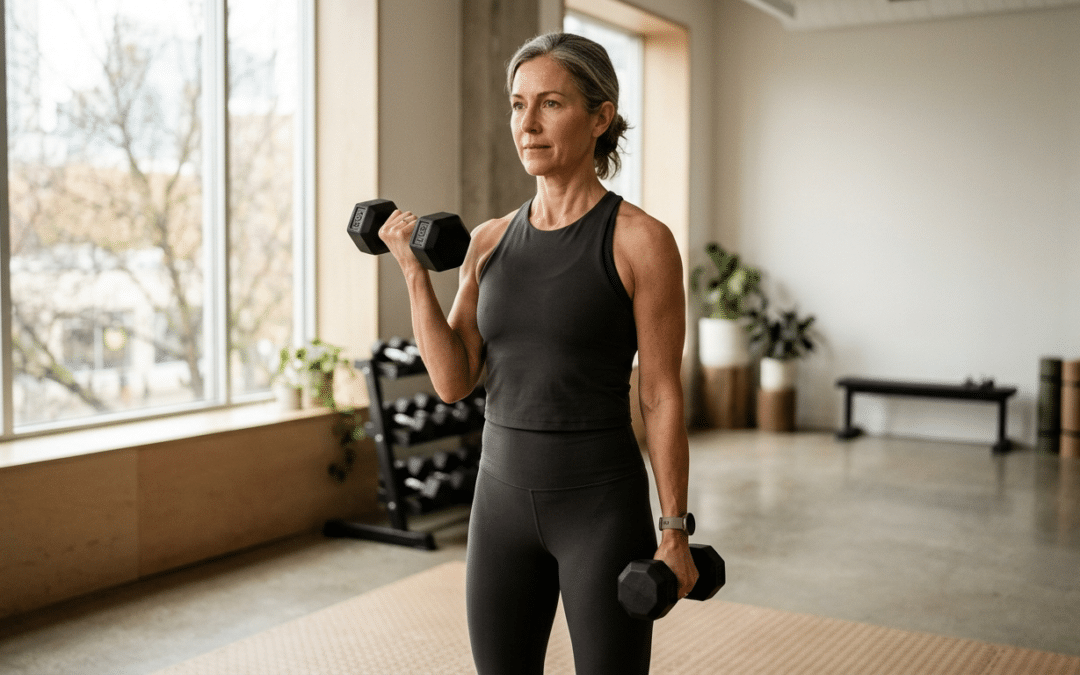
Resistance training is the single most effective intervention for sarcopenia. That is not a matter of debate in the research literature; it is one of the clearest findings in all of exercise science. Lifting weights, or working against any meaningful form of resistance, signals the body to preserve and rebuild muscle tissue. The stimulus does not need to be extreme. It needs to be consistent and progressively challenging over time.
For adults in their forties, fifties, and beyond, two to three sessions of resistance training per week is generally sufficient to produce meaningful results. The exercises do not need to be complicated. Compound movements like squats, deadlifts, rows, and presses that work multiple muscle groups simultaneously tend to be the most efficient use of training time.
Protein intake matters considerably as well. Older adults require more dietary protein than younger adults to achieve the same muscle-building response, a phenomenon researchers call “anabolic resistance.” Current evidence generally supports a daily intake of around 1.2 to 1.6 grams of protein per kilogram of body weight for active adults over forty, though individual needs vary. Spreading protein across meals rather than concentrating it in a single sitting appears to improve how well the body uses it.
Worth remembering: Sleep is not a passive state where muscles simply rest. A significant portion of muscle repair and growth happens during deep sleep, when the body releases growth hormone. Consistently poor sleep undermines the benefits of even a well-designed training program.
It is not too late to start

One of the more encouraging findings in this area of research is how well the body responds to resistance training regardless of age. Studies involving adults in their seventies, eighties, and even nineties consistently show meaningful gains in muscle strength and functional capacity after relatively short training periods. The body’s capacity to adapt does not disappear, it simply requires a more deliberate effort to activate.
Beginning a resistance training program at forty is obviously preferable to beginning at sixty, and beginning at sixty is preferable to beginning at seventy. But the honest point is that beginning at any age produces real benefit. The physiology is on your side. What is required is a willingness to show up regularly and work with some degree of effort.
If you are not sure where to start, that is a reasonable place to be. Figuring out what your body needs, how to train safely, and how to build a routine that holds up over time is exactly the kind of thing a good trainer is for. The muscle you preserve — or rebuild — in your forties and fifties will matter enormously in your sixties and beyond. There is no better time to take it seriously than now.
I offer one-on-one and group training sessions tailored to your goals and where you are right now. Reach out to learn more.
