

Building Consistency: How to Maintain Your Routine Through Fall
Every year, around the second week of October, my calendar starts to tell the same story. Sessions that ran like clockwork in July begin to move. One client has a school meeting. Another looked out the window at 5:45 in the morning, saw that it was still dark, and went back to bed. Nobody decided to stop training. The routine simply came loose, one reasonable excuse at a time.
If that sounds familiar, you are in good company. Fall is the season when most routines are tested, and it has very little to do with willpower.
So how do you maintain your routine through fall? You change the routine before the season changes it for you. Decide in advance when and where you will train. Set a minimum that you will meet even in a poor week. Tie your workouts to parts of the day that will hold steady when the clocks go back on November 1. A routine built on summer conditions will struggle in October. A routine rebuilt for shorter days will last until spring.
The rest of this post explains why fall is hard on good habits, what the research says about keeping them, and the steps I give my own clients at this time of year.
Key Takeaways
- Activity falls in autumn for most people, so a slipping routine is a seasonal pattern and says nothing about your character.
- A habit takes about two months to settle, which means a routine started or repaired in October can be automatic by the holidays.
- A single missed workout does no lasting harm. A missed week is what you need to guard against.
- A written plan with a day, a time, and a place is far more reliable than good intentions.
Why Is It So Hard to Stay Consistent in the Fall?

Summer does a good deal of the work for you. The mornings are bright, the evenings are long, and a walk after dinner hardly feels like exercise. You can miss your planned session and still end the day having moved quite a lot.
Fall removes that help. Three things change at once.
The light goes. By late October the sun rises after many people have left for work, and the end of daylight saving time on November 1 takes an hour off the evening as well. A run that felt pleasant at 6 p.m. in August now happens in the dark.
The calendar fills. School is back, work projects that paused over the summer return, and the holidays begin to make demands weeks before they arrive. Exercise is usually the first appointment to be moved because it is the one you made with yourself.
The weather turns. Cold and rain do not prevent a workout, but they add a small decision to every session. Do I still go? What do I wear? Is it worth it today? Each of those questions is a chance to say no.
Clients who trained three times a week all summer arrive in November having managed one session in the previous two weeks.
What Does the Research Say About Exercise Habits and the Seasons?
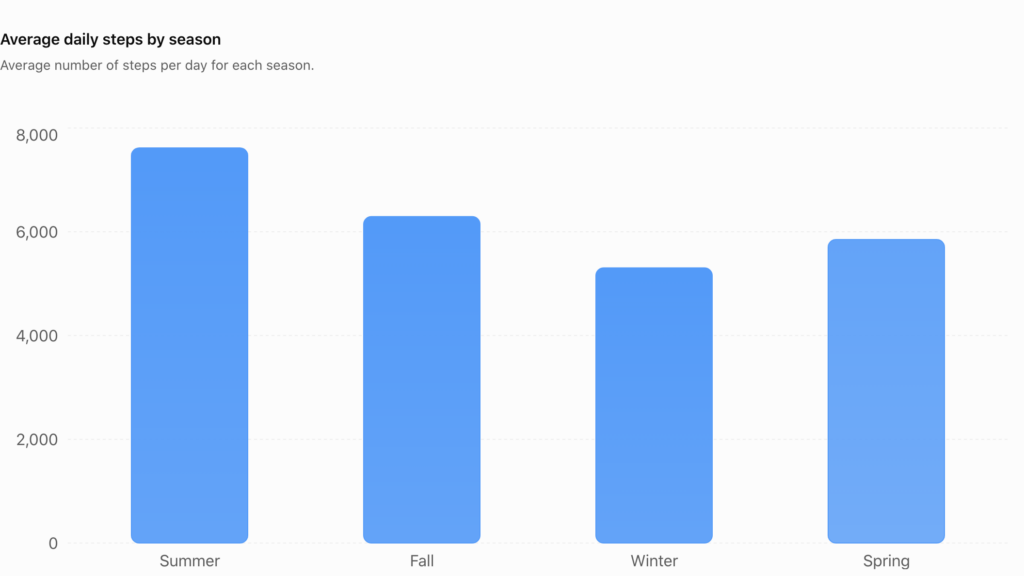
The autumn dip is well documented. Researchers at the University of Pittsburgh tracked pedometer readings for women in their fifties and found an average of 7,616 steps a day in summer and 6,293 in fall. That is a loss of roughly 1,300 steps a day, or about 17 percent, before winter has even begun. Winter brought the figure down again to 5,304.
The same study holds the encouraging part. Women who received structured coaching in the trial kept their activity far steadier across the year. Their month-to-month variation was less than half that of the comparison group. The season still changed. Their support and their plan did not.
The second finding concerns time. A well-known study from University College London followed 96 volunteers as they tried to build a daily habit and found that it took an average of 66 days for the behavior to become automatic, with individual results ranging from 18 to 254 days. A 2024 review from the University of South Australia, covering 20 studies and 2,601 people, reached a similar conclusion. The median was 59 to 66 days, and some people needed most of a year.
The London researchers also reported something that every person with a busy life should hear. Missing one opportunity to perform the behavior did not meaningfully affect the habit. People who were very inconsistent, however, did not form one at all.
The third finding concerns planning. In a British experiment published in 2002, students who wrote down the day, time, and place of their next workout followed through at a rate of 91 percent. In the two groups that did not make a written plan, fewer than four in ten exercised, including a group that had been given motivating material about the benefits of exercise.
Put plainly, the students who exercised were the ones who had a specific plan. Extra motivation made very little difference.
Why Should You Plan for Your Worst Week?
Most people write a training plan for their best week. Three sessions, every one completed, perfect sleep, no late meetings. Then an ordinary October week arrives, the plan fails by Wednesday, and they give up on the remainder.
I like to plan the other way round.
What is the least you will do in a week when everything goes wrong? It is small on purpose. Two sessions of twenty minutes is good for many people.
The research explains why this works. One missed workout does not damage a habit, but long gaps do. My plan prevents long gaps. In a hard week you still train twice, the pattern stays alive, and you return to your full plan the following Monday without having to start again.
Consistency means never falling below your minimum.
What Does a Fall-Proof Routine Look Like?
A routine that survives the fall has three features. It is tied to fixed points in your day, it has an indoor version, and it involves at least one other person.
Fixed points. Clock times drift when the light changes. Events hold. “After I drop the children at school” or “straight from the office, before I go home” will still be true in December.
An indoor version. Every outdoor workout needs a substitute that you have chosen in advance. If Tuesday is a three-mile walk, the wet-weather version might be twenty-five minutes on a treadmill or a bodyweight circuit in the living room. The decision is made once, in good weather, and never again at 6 a.m. in the rain.
Another person. An appointment with someone else is harder to cancel than an appointment with yourself. A training partner, a class, or a standing session with a trainer all serve the same purpose.
Here is how that might look for someone whose full plan is three strength sessions and two walks.
| Full plan | Minimum | |
|---|---|---|
| Strength | Monday, Wednesday, Friday, 30 minutes | Monday and Friday, 20 minutes |
| Walking | Tuesday and Saturday, 40 minutes outdoors | One 15-minute walk at lunch |
| Fixed point | After school drop-off | After school drop-off |
| Bad-weather version | Treadmill or home circuit | Home circuit |
The full plan sits comfortably within the national guideline of 150 minutes of moderate activity and two days of strength work each week. The minimum plan short of it, and that is acceptable for a week or two. Its purpose is to keep the habit intact until the full plan is possible again.
How Do You Build Consistency This Week? Seven Steps

- Review your summer schedule. Write down every session you were doing in August. Beside each one, note whether it still works in the dark, in the cold, and with your fall commitments. Keep what works and move what does not.
- Write next week’s plan on Sunday evening. Give each session a day, a time, and a place. “Wednesday, 7:15 a.m., the gym on Main Street” is a plan. “Three times this week” is a hope.
- Set your minimum. Decide the least you will do in a bad week and write it beneath the full plan. Keep it small enough that you could manage it with a cold and a deadline.
- Choose an indoor version of every outdoor workout. Decide now what replaces the walk, the run, or the bike ride when the weather is poor. Put the equipment where you can see it.
- Prepare the night before. Lay out your clothes, shoes, and water bottle. If you train outdoors before sunrise or after sunset, add a reflective layer and a light. A dark morning is much easier to face when nothing has to be found.
- Book at least one session with another person. A trainer, a group class, or a friend will do. Put it in your calendar as you would a medical appointment.
- Follow the day-after rule. When you miss a session, the next one happens regardless, even at floor length. One missed day is ordinary. Two in a row is the beginning of a new habit that you do not want.
Frequently Asked Questions
How long does it take to build an exercise habit?
Most research puts the figure at about two months. A University College London study found an average of 66 days, and a 2024 review reported a median of 59 to 66 days. Individual results vary widely, so expect anywhere from a few weeks to several months of regular practice.
Will missing one workout ruin my progress?
No. Research on habit formation found that a single missed day had no meaningful effect on the habit. Long gaps are the real risk. If you miss a session, complete the next one as planned, even in a shorter form, and your routine will remain intact.
Is it better to exercise in the morning or the evening during fall?
The best time is the one you can keep. Some research suggests that morning habits form more strongly, and mornings are less likely to be interrupted by the day’s demands. If you prefer evenings, move the session indoors once it is dark and tie it to a fixed point such as leaving work.
How many days a week should I work out to stay consistent?
For most adults, three or four planned sessions a week is a sound target, with a floor of two in difficult weeks. National guidelines recommend 150 minutes of moderate activity and two days of strength training each week. Regular, modest sessions will serve you better than occasional long ones.
How do I stay motivated to exercise when it is cold and dark?
Rely on preparation more than motivation. Lay out your clothes the night before, choose an indoor alternative in advance, and arrange to train with another person. Motivation rises and falls with the weather, while a prepared plan and a waiting partner work on any morning.
The Routine That Lasts Until Spring
Think again of that dark window at 5:45 in the morning. The person who goes back to bed and the person who gets up are often equally tired and equally busy. What separates them is usually a decision made the evening before. One of them has clothes on the chair, a plan on paper, and somebody expecting them.
You have about twelve weeks between now and the new year. That is enough time for a routine to become automatic, which means you could begin January already doing what most people will only be resolving to do.
So take twenty minutes this weekend. Review your summer schedule, write next week’s plan, and set your floor. If you would like help building a plan that fits your fall, contact me, and I would be glad to see you there.
The weather will change. Your routine can stay.
Keep Learning
- Sleep and Recovery: The Missing Link in Your Fitness Results. Why rest determines how much you gain from each session.
- Stress Management and Physical Wellness. How a busy season affects your body and what to do about it.
- New Year Strength: Building a Foundation That Lasts. The strength basics that every routine should include.
Image Recommendations
Seven images are suggested, one header and six within the post. Photographs of Nicole and her own clients, used with their permission, will serve the post better than stock images wherever they are available.
| Placement | Image | File name | Alt text |
|---|---|---|---|
| Header | A person tying running shoes on a front step at dawn, fallen leaves on the ground, porch light on | fall-workout-routine-consistency.jpg | Woman tying her running shoes on a front step at dawn in fall, ready to keep her workout routine |
| Why Is It So Hard | A bedside clock reading 5:45 with a dark window behind it | dark-fall-morning-workout.jpg | Alarm clock showing 5:45 a.m. beside a dark window on a fall morning |
| What Does the Research Say | A simple bar chart of average daily steps by season: summer 7,616, fall 6,293, winter 5,304, spring 5,850 | average-daily-steps-by-season.png | Bar chart showing average daily steps falling from 7,616 in summer to 6,293 in fall and 5,304 in winter |
| Why Should You Plan for Your Worst Week | A branded graphic showing the Floor Week beside the full plan, sized for sharing on social media | floor-week-exercise-plan.png | Graphic comparing a full weekly exercise plan with a smaller Floor Week plan |
| What Does a Fall-Proof Routine Look Like | Nicole leading a small group session indoors | fall-group-training-session.jpg | Personal trainer Nicole leading a small group strength session indoors in fall |
| Seven Steps | Workout clothes, shoes, a water bottle, a reflective vest, and a headlamp laid out on a chair or bed | workout-clothes-laid-out-night-before.jpg | Workout clothes, shoes, and reflective gear laid out the night before a morning workout |
| About the Author | A friendly headshot of Nicole | nicole-personal-trainer.jpg | Nicole, personal trainer and founder of Train with Nicole |
Publishing Notes
- SEO title: How to Stay Consistent With Exercise in the Fall
- Meta description (144 characters): Learn how to maintain your workout routine through fall with a simple weekly plan, a realistic minimum, and seven steps from a personal trainer.
- Primary keyword: how to stay consistent with exercise in fall
- Related terms: fall workout routine, how long to build an exercise habit, working out when it gets dark early, exercise motivation in cold weather
- Nicole to confirm the first-person observations and add the client example in the Floor Week section
- Complete the author bio with certifications, experience, and location
- Link the five Keep Learning titles to their posts
- Apply FAQ schema to the Frequently Asked Questions section
- Add “Last Updated: October 2026” beside the byline
- Remove the Image Recommendations and Publishing Notes sections before the post goes live
Sources
- Monthly Variation in Physical Activity Levels in Postmenopausal Women, Newman and colleagues, Medicine and Science in Sports and Exercise, 2009
- How long does it take to form a habit?, University College London, on the study by Lally and colleagues in the European Journal of Social Psychology
- Time to Form a Habit: A Systematic Review and Meta-Analysis of Health Behaviour Habit Formation and Its Determinants, Singh and colleagues, Healthcare, 2024
- ScienceAlert summary of Milne, Orbell, and Sheeran, British Journal of Health Psychology, 2002
